
Facebook Ads MCP Explained: Safe AI Control of Meta Ads
Facebook Ads MCP explained: how Claude and ChatGPT read Meta ad data, what they can change, and which approvals keep spend safe.
Facebook Ads MCP is a connector that lets an AI client such as Claude or ChatGPT read a Meta ad account and, where the tool allows, make changes to it through the Model Context Protocol, the open standard Anthropic published on November 25, 2024. That date explains the gap most explainers skip: the protocol settles how an assistant reaches your account, and says nothing about what it should be trusted to do once it arrives.
Every team that connects an account answers three questions on its own. What runs unattended. What waits for a person’s yes. What evidence survives afterwards, when a client asks who raised a budget and why. The protocol doesn’t answer any of them. The connector’s guardrails and your own rules do.
Table of Contents
- What Facebook Ads MCP Means in Plain Terms
- Dashboard, API and MCP Compared Side by Side
- How an AI Client Reads and Changes a Campaign
- Which Changes Run Alone and Which Need a Yes
- Credentials, Permissions and the Activity Record
- Where MCP Stops and the Marketing API Takes Over
- Start With Read-Only Questions Before Any Change
What Facebook Ads MCP Means in Plain Terms
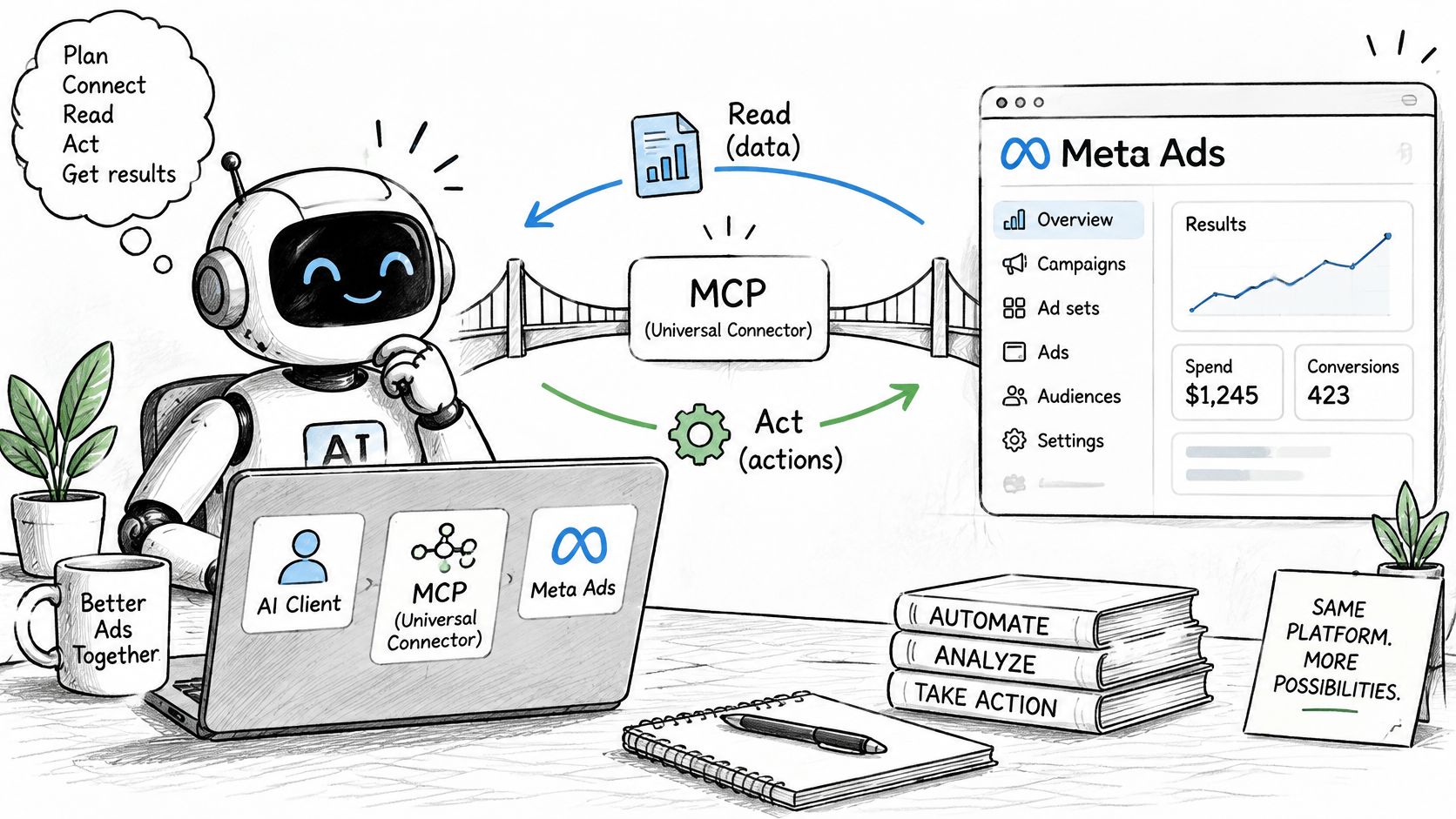
Facebook Ads MCP is a connector between an AI assistant and a Meta ad account. You ask a question or request a change in Claude, ChatGPT or AdCrunch’s Adgent, the connector carries it to Meta, and the answer comes back as a table of numbers or as a proposed change waiting for approval.
Think of MCP as a universal power adapter. One standard plug shape lets many assistants reach many outside tools: a calendar, a code repository, an inventory system, an ad platform. Before the standard existed, each of those connections was a custom cable, built and maintained separately.
Three parts worth naming separately
The MCP server is the adapter. It holds the authorised connection to the ad platform and publishes a fixed set of tools, each with a name and a description the assistant can read. AdCrunch runs one at a single connector address, so Claude, ChatGPT and the Adgent all reach the same account the same way.
The AI client is the assistant that asks. Claude and ChatGPT are general-purpose clients. The Adgent is the chat agent inside the AdCrunch console, which keeps the conversation and the activity record in one place.
The ad account is the Meta side: campaigns, ad sets, ads and the budgets attached to them. The spend lives here, not in the connector, and not in the model.
MCP isn’t an advertising network, and it isn’t a Meta-owned API. Anthropic announced it as an open standard for secure, two-way connections between AI applications and data sources, intended to replace fragmented, one-off integrations with a shared protocol, per the original MCP announcement.
The connection is three parts and one direction: assistant on the left, connector in the middle, ad account on the right.
Adoption is running ahead of the guardrail conversation. The share of advertisers reporting at least one live generative-AI use case increased from 9% in April 2024 to 41% in July 2025, according to ISBA figures reported by Marketing Week. If you’ve watched the same shift elsewhere, connecting AI agents through Zapier shows the pattern in a non-ad setting: one protocol replacing a shelf of hand-built integrations.
AdCrunch, the connector used as the reference point here, is built for agencies, freelance media buyers and in-house teams at brands.
The AI asks, the connector carries the request, and the guardrails decide what runs. That third piece is where accounts get lost or kept safe.
Dashboard, API and MCP Compared Side by Side
The routes into a Meta ad account differ on one practical point: who makes the change and who signs off. A dashboard, a script and an MCP server can all move a budget, and they don’t share the same approval step.
The money involved rewards a deliberate choice. Global social-media advertising spend was projected to reach $276.72 billion in 2025, a 13.6% increase from 2024, according to Statista as reported by Digiday.
| Method | Reads account data | Makes changes | Approval step |
|---|---|---|---|
| Ads Manager dashboard | Yes | Yes, by hand | The person clicking |
| Direct Marketing API script | Yes | Yes, as coded | Only the checks written into the code |
| Meta official MCP server | Reporting and structure | Campaign, audience and experiment changes | Recommended by MCP guidance, not enforced by the protocol |
| Third-party MCP server | Usually, for reporting | Some of them | Whatever the vendor built |
| AdCrunch with Claude, ChatGPT or the Adgent | Yes, on Meta, TikTok and Google Ads | On Meta: budgets, bids, schedules, builds, status. On TikTok: media uploads to an ad account’s library | A person confirms spend-starting changes and budget increases |
Reading the rows in order
The dashboard reads everything and changes anything, and its approval step is whoever is clicking. A budget raised at 11pm is approved by whoever is still awake.
A direct script is fast and repeatable, and its only safety check is the one written into the code. Nothing in the script notices that the ad set it edits belongs to a different client’s campaign.
An MCP server adds a conversational layer on top of one of those two paths, so it inherits whichever route it calls plus whatever guardrails the vendor supplies. Two servers sitting in the same row can behave nothing alike.
Meta’s own server is the widest first-party surface. It combines reporting, campaign management, audience operations, experiments and activity-log visibility in one place, as the Meta Ads MCP server overview describes it.
AdCrunch reads performance and account structure on Meta, TikTok and Google Ads from one connection, and on Meta it changes budgets, bids, schedules, builds and status, while on TikTok it can upload images and videos to an ad account’s library. The reasoning behind that split is set out in how an MCP server fits ad operations. Its approval column is also the strictest in the table: a person confirms in the console each agent change that starts spend, raises a budget or archives, and no organization can switch that confirmation off.
Three checks settle most comparisons. Does it read only? Can it write at all? When it writes, does a person sign off before spend rises?
How an AI Client Reads and Changes a Campaign
Ask an AI client, “Which ad sets spent the most last week?” The client translates that question into a structured API call. The connector sends the call over an authorised connection, and the workflow returns data, an API error, an applied change or a proposal awaiting a person’s approval.
The trip has five steps.
- You ask in plain language. The client maps the request to an account object, such as an ad account, campaign, ad set or ad, and decides whether you want information or a change.
- The client calls a tool. A read tool requests account structure or performance. A write tool submits a change such as a budget, bid, schedule or status update.
- The connector calls Meta’s Marketing API. The request travels over the authorised connection. The model receives the result, not the token that authorises the call.
- Meta processes or rejects the request. Meta’s API rejects a request that names an object it cannot find or process. A request aimed at a different existing ad set can still be valid, so the destination object remains a review point.
- The response comes back. A read returns structured metrics or account structure. A write returns the changed object when it is allowed to run. Where a connector requires approval, the change stays proposed until a person confirms it.
Why the account tree decides what a request can touch
Meta’s structure works like a filing cabinet. Campaigns are drawers, ad sets are folders and ads are the sheets inside. An ad set’s own budget, schedule, bid and targeting data sit in its folder, so a request to change that ad set’s daily budget names the ad set rather than each ad inside it.
The Marketing API getting-started guide models an ad set as a group of ads that share budget, schedule, bidding and targeting data. Creating one accepts a campaign ID, an optimization goal, a billing event, a bid amount, and either a daily or lifetime budget. Those fields explain why an MCP server can expose budget, bid and schedule edits as tools. They do not make every edit available to every agent, because each server sets its own tools and permissions.
The API represents an advertising operation at considerable scale. Meta reported advertising revenue of $196.175 billion for full year 2025, up from $160.633 billion in 2024, with 3.58 billion average daily active people across its family of services in December 2025, per Meta’s reported results. The Marketing API models ad objects as campaigns, ad sets, creatives and ads, and the Insights API returns performance statistics through a consistent interface.
This structure creates two kinds of failure. A malformed request, or one naming an object Meta cannot find, is rejected. A valid request sent to the wrong existing object can be processed for that object. The API has no way to know that “the retargeting ad set” meant a different folder in the cabinet.
That difference is the control point. Reading asks Meta to return existing data, so a wrong object produces the wrong answer. Changing a live object asks Meta to alter its state, so a wrong object can produce the wrong campaign change. For a spend-starting or budget-raising request, the account, object level, field and proposed value are the details a person needs to see before saying yes.
Which Changes Run Alone and Which Need a Yes
Reading is routine. Anything that starts spend or raises a budget needs a person to confirm it, and that single line does more work than any prompt you’ll write.
| Action | Example | Rule on AdCrunch |
|---|---|---|
| Read performance and structure | Spend, CTR and ROAS by campaign, ad set or ad | Runs without a confirmation step |
| Build a campaign, ad set or ad | New campaign with its ads | Arrives paused; a person confirms the start of spend |
| Raise a budget | Daily budget increased on an ad set | A person confirms the change |
| Change a bid or schedule | Lower a bid or shift ad set hours | Runs as permitted; a person confirms if it starts spend or raises a budget |
| Pause an ad | Pause one underperforming ad | Runs without a confirmation step |
| Restart an ended ad set | Turn an ended ad set back on | A person confirms, because it starts spend |
| Archive a finished ad set | Archive a completed ad set | A person confirms, and archiving on Meta is close to permanent |
| Change targeting of an existing ad set | Narrow the audience | Not allowed for the agent |
| Hard-delete anything | Remove a campaign permanently | Not allowed for the agent |
The clock rule behind every schedule change
Meta’s scheduling documentation expresses ad scheduling as time ranges in zero-based minutes of the day and active weekdays as integers from 0 through 6, where 0 is Sunday and 6 is Saturday. The same documentation separates daily from lifetime budgets and explains that pacing uses the schedule when it calculates delivery and bids, per Meta’s pacing and scheduling guide.
That’s what makes a schedule edit worth understanding. Moving an ad set’s hours changes when delivery happens, and pacing then recalculates bids inside the budget you’ve already set. A bid or schedule change can raise spend only up to the budget, which is why those edits sit in a lower tier than a budget increase.
Three tiers worth writing down before you connect
- Low risk, no confirmation. Reading performance, structure and spend.
- Medium risk, reviewed after the fact. Pausing an underperforming ad, trimming a bid, shifting ad set hours.
- High risk, confirmed first. Raising a budget, launching a campaign, archiving a finished ad set, restarting an ended one.
Write the tiers down before the first connection. A rule your team agreed to in a document survives a busy Friday. A rule you plan to remember does not.
The tiers only pay off if the work gets measured. Measuring whether AI output drives sales is where the loop closes, because a change nobody can attribute to a result is just activity. For the scheduled side that sits outside the conversation, our guide to Meta ads automation covers the rest.
Then test the confirmation flow on one low-stakes account. Watch which changes pause for a yes and which run straight through, and fix the mismatch before a second account is connected.
Credentials, Permissions and the Activity Record
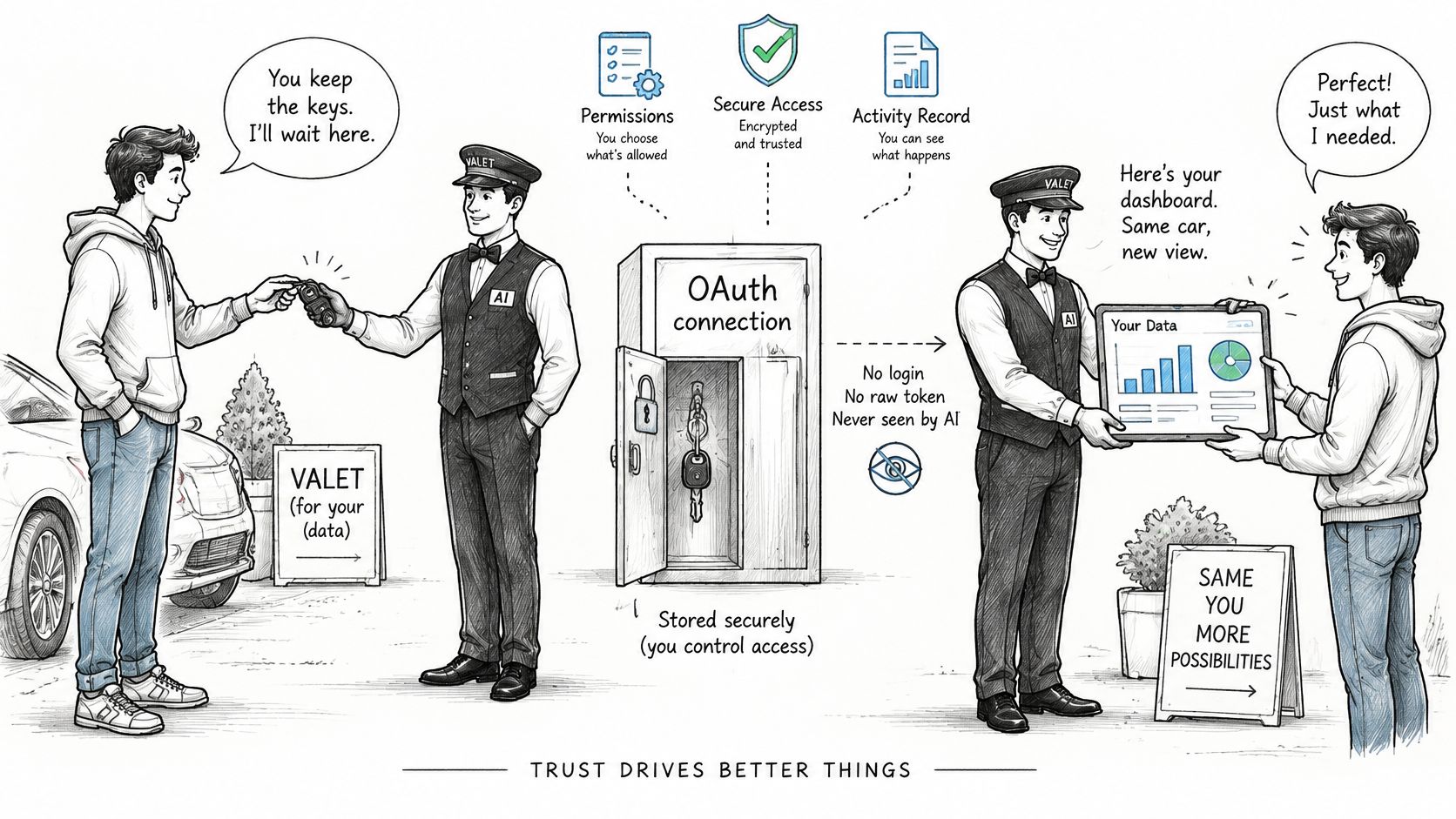
The AI model never receives the Meta login or a raw access token. The connector holds the OAuth connection and makes the provider call itself, then hands back typed results and the actions the assistant is allowed to take.
A valet parks the car without getting the keys to your house. That’s the split here: the model gets the parking space, not the keyring. AdCrunch doesn’t store customers’ ad account credentials and keeps only the OAuth tokens needed to provide the service, connects with read-only scopes or the minimum required scopes, and won’t sell that ad data or use it for marketing unrelated to the service.
Two permissions that do different jobs
On Meta, ads_read supports reporting and inspection, while ads_management is required for write operations such as creating or modifying advertising objects, as the Marketing API overview explains. Production access also passes through app review, so it’s worth knowing which permission a connection uses before anyone grants it.
The MCP authorization specification adds a second layer on top of Meta’s own. It requires OAuth 2.1 protections for HTTP transports, HTTPS for authorization endpoints, and validation that a token was issued for this server before a request is processed, per the MCP authorization specification. That last check is what stops a token minted for one service from being replayed against another.
The credentials stay outside the model’s context for the whole exchange.
What the record has to show
Every change lands on the Activity page with the ad account, the exact change, who asked for it, who confirmed it and how it ended. That’s the difference between a conversation and a change log.
A good record answers four questions. Who asked. Who approved. What changed. What happened next.
If you want to test a connector before it touches live spend, sandboxed environments for MCP servers are worth understanding as a pattern.
Once a quarter, check three things.
- Accounts. Which ad accounts are connected, and which client or brand each one belongs to.
- People. Who can confirm a change, and whether that list still matches the team.
- Entries. Which Activity records from the last three months need a follow-up conversation.
Where MCP Stops and the Marketing API Takes Over
MCP is an interaction layer for investigation and controlled edits. It isn’t a replacement for the Marketing API, and treating it as one leaves gaps a team won’t notice for a month.
The clearest evidence is what a hosted server doesn’t expose. Lead retrieval, Conversions API event sending, automated ad rules, duplication workflows, asynchronous Insights jobs and webhooks have been reported as omissions, as Scalekit’s comparison of the Meta Ads MCP and the API sets out, and the same write-up dates the hosted server’s open beta to April 29, 2026. Capability expands quickly. The assumption that “official” means “complete” doesn’t get safer as it does.
Meta’s Marketing API can programmatically adjust bids, stop and start ads, and reallocate spend when custom rules or thresholds are applied, per Meta’s Marketing API documentation. Meta’s best-practices documentation separately notes that changes to bid amount, budget and ad-set schedule don’t affect an ad’s review status.
So split the work by what it needs.
- Use MCP for questions about performance, structure checks, building a campaign that lands paused, and edits a person confirms.
- Use scheduled API jobs for bulk changes across many accounts, rule engines that run every hour, event pipelines, webhooks and reconciliation with your own reporting.
Check the date window before you act on a number. A budget decision made from an incomplete attribution window is a guess with a receipt.
For the deeper mechanics on the underlying layer, the Facebook advertising API explained walks through the objects and endpoints a scheduled job depends on.
One more constraint belongs in the plan. AdCrunch isn’t responsible for outages or inaccuracies caused by third-party ad platform API changes, so anything that must reconcile to the cent needs a deterministic job rather than a conversation.
Start With Read-Only Questions Before Any Change
Start with read-only questions, then approve one small change in a test account, and only then extend to the rest. Setup takes a few minutes: connect the ad accounts, add the connector, and ask the first question.
- Connect each ad account through the official OAuth flow. Pick the account you know best, and start at the narrowest scope the connector offers.
- Add the connector. The address for adding AdCrunch to an AI client is mcp.adcrunch.dev/mcp. Add it as a custom connector in Claude or ChatGPT, or open the Adgent in the AdCrunch console.
- Ask something with a known answer. “Last week’s spend by ad set” is the right first question, because you can check it against Ads Manager in a minute.
- Request one paused build, then one small budget decrease. Open the console and check both, rather than trusting the chat transcript.
- Open the Activity page. Each change should carry its own entry with the account, the change, who asked, who confirmed and how it ended.
Agencies running a client roster can see how the account-level setup works at AdCrunch for agencies, and in-house teams managing several brands can start at AdCrunch for brands.
Pro costs $99 a month, flat, with unlimited ad accounts and unlimited seats, and the 7-day trial charges nothing for 7 days. The plan details sit on the AdCrunch pricing page.
Then apply one rule. If the first read matches Ads Manager and the first change shows correctly on the Activity page, extend to the next account. If either one misses, stop and fix the connection before a second account inherits the problem.
AdCrunch connects Meta, TikTok and Google Ads accounts to Claude, ChatGPT and the Adgent, reads performance across all three, and on Meta it changes budgets, bids and schedules. A person confirms each change that starts spend or raises a budget, and every action lands on the Activity page with who asked, who confirmed and how it ended. Connect an account at AdCrunch and ask the first read-only question before you approve a single change.